


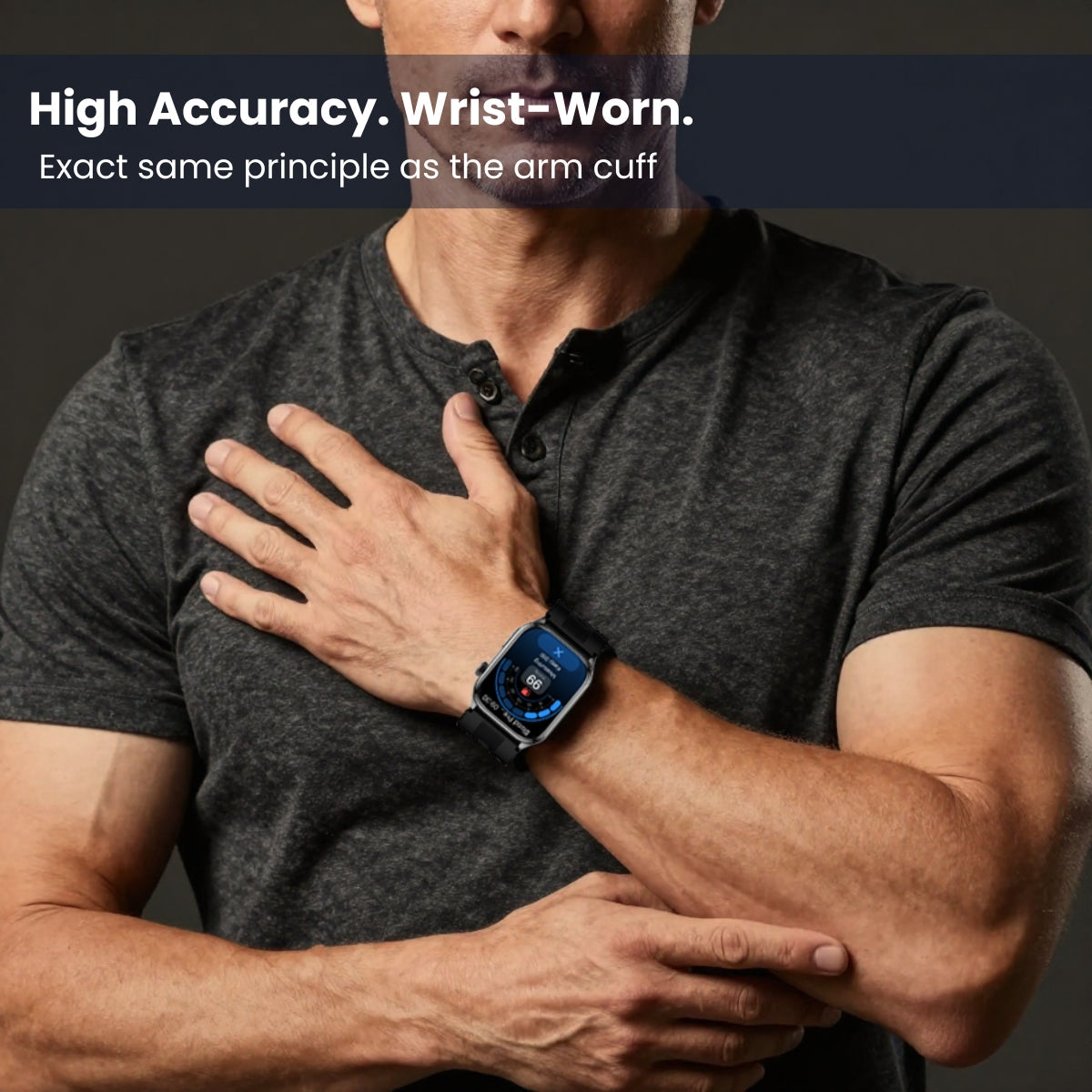
When people compare a blood pressure watch vs an upper arm cuff, the conversation usually turns into a contest. It should not. The two tools were designed for different moments, and once you see what each one is good at, they stop competing and start working together. If you own a cuff already and are considering a watch, the CXS200 Air-Cuff Smartwatch is a useful example of how a wrist device fits into the same routine.
Two tools, two jobs
An upper arm cuff is built for one thing: a still, seated reading taken on purpose. You sit down, wrap the cuff, stay quiet, and get a single number at a single moment.
A watch is built for a different thing: catching readings throughout the day, in context, and turning them into a trend. One gives you a point. The other gives you a line.

The CXS10 takes its reading the same basic way an upper-arm cuff does — just from the wrist.
What an upper arm cuff does best
- A deliberate, rested reading. Because you sit still for it, there is less room for movement to interfere.
- A familiar reference point. If you have used a cuff for years, its numbers are the ones you already know.
- A fixed routine. Many people take it at the same time each day, which makes comparisons easy.
- A setup that barely changes. Same cuff, same arm, same position every time — year after year. That kind of consistency is hard to beat as a long-term baseline.
What a watch adds
A blood pressure smartwatch fills in the hours a cuff cannot cover. Three situations make the difference obvious:
- Morning baseline. A reading within a few minutes of waking, before coffee or a commute.
- After activity. A quick check once you have cooled down, to see how your body settles.
- Evening wind-down. A calm reading before bed, taken while seated and relaxed.
Individually those numbers mean little. Stacked over two weeks, they start to show a pattern — and patterns are what you can actually act on.

A watch reading takes seconds — no cuff, no setup, no appointment with yourself.

CoxSmart CXS200 Air-Cuff Smartwatch
- Air-cuff reading on demand
- Trend history in the app
- Family sharing and SOS
Position matters more than the device
Here is the part most comparisons leave out. When a wrist reading and an arm reading disagree, the cause is usually the setup, not the hardware.
- Height. A wrist held below heart level reads higher; held above, it reads lower. Rest your forearm on a table so the watch sits roughly level with your chest.
- Support. Back against a chair, feet flat on the floor, legs uncrossed. Holding your arm up unsupported changes the reading.
- Stillness. Talking, clenching, or shifting during the reading moves a wrist signal more than it moves an arm cuff signal.
- Timing. Five quiet minutes before you start. No caffeine or exercise in the previous half hour.
- Repetition. Two or three readings, a minute apart, averaged. Never judge on a single pair.
Fix those five things and most of the gap people complain about simply disappears.
How to run a fair seven-day comparison at home
If you want to know how your own two devices relate, do it properly rather than by instinct:
- Pick two fixed moments. Within an hour of waking, and again in the evening before dinner.
- Same setup every time. Same chair, same arm, same posture, five minutes of rest first.
- Cuff first, then watch. Take the arm reading, wait about a minute, then take the wrist reading. Keep the order identical all week.
- Two readings each, one minute apart. Write down the average, not the first number you saw.
- Do it for seven days. Then compare the weekly averages, not individual days.
What you are looking for is whether the two track together — do they rise and fall on the same days? Day-to-day agreement in direction tells you far more than any single comparison.
What to log beside every reading
A number without context is just a number. Four short notes make a trend readable months later:
- Time of day — morning, midday, evening.
- What you had just done — walked, had coffee, sat in a meeting, just woke up.
- How you slept — hours, and whether you woke during the night.
- How you felt — rushed, calm, stressed. One word is enough.
Three weeks of that turns a list of numbers into something you can actually reason about — and into something worth showing a healthcare professional.
Where a watch genuinely wins
Convenience is not a small thing, because consistency comes from convenience. A watch wins when:
- You travel. A cuff is another item to pack and another thing to find a flat surface for.
- Your day is not at home. A reading at the office, in the car park before you go in, or after an evening walk.
- You forget. A reminder on your wrist is easier to act on than a device in a drawer.
- Someone else is watching. Family sharing means a relative can follow your trend with your permission, without you having to remember to report it.
Using them together
The most sensible routine uses both. Take your cuff reading as your regular reference point. Use the watch to fill in the rest of the day and to spot patterns. When you compare the two, do it fairly: same arm, same posture, same time of day, and a few quiet minutes before each.
If the two ever disagree on a given day, resist the urge to draw a conclusion from one pair of readings. Look at the trend instead, and talk to a healthcare professional about anything that concerns you.
Which one fits your life?
| If you want… | Reach for… |
|---|---|
| One still, seated reading on a fixed schedule | An upper arm cuff |
| Readings through the day and a trend over weeks | A blood pressure smartwatch |
| Something you will actually remember to use while travelling | A blood pressure smartwatch |
| The same setup year after year as a baseline | An upper arm cuff |
| The full picture | Both — cuff as reference, watch for context |
FAQ
Is a watch reading the same as a cuff reading?
They come from different mechanisms, so expect small differences. What matters is consistency over time, not a single pair of numbers.
Should I stop using my cuff?
No. A cuff remains the familiar reference point for many people. The watch is an addition, not a replacement.
Can I share readings with family?
Many smartwatches, including the CXS200, support family sharing so a relative can follow along with permission.
How far apart should the two readings be?
About a minute. Take two or three in a row, discard nothing, and use the average. Comparing one wrist reading against one arm reading taken five minutes apart is not a fair test.
Can I use the watch while travelling?
Yes — that is one of its strengths. Just keep the routine the same: sit down, rest five minutes, wrist at heart height. Time zone changes will shift your pattern for a day or two, which is worth noting in your log rather than worrying about.
Ready to add a watch to your routine?
Use code COX05 for 5% off
Free shipping to the US, Canada, Australia, UK, and New Zealand · 30-day returns
The bottom line
A cuff gives you a number; a watch gives you a story. Use the cuff as your anchor and the watch to see everything in between — that combination tells you far more than either one alone. And whichever you reach for, the same rule applies: sit still, keep the wrist at heart height, average two or three readings, and read the line rather than the dot.
Disclaimer: This product is not a medical device. The blood pressure tracking feature is intended for general fitness and wellness management only. Always consult a qualified healthcare professional before making changes to your health routine.
Share:
How Air-Cuff Blood Pressure Watches Work (2026 Guide)
How to Track Blood Pressure at Home with a Smartwatch